
Best Fine Motor Skills

📖 Table of Contents
- What Good Fine Motor Skills Actually Look Like at Each Age
- The Five Activities That Moved the Needle Fastest
- The Toys Worth Buying (and the Five I Returned)
- How to Build a Daily Practice Without It Feeling Like Homework
- Red Flags, Realistic Timelines, and When to Call an OT
- Make It Your Way
- Frequently Asked Questions
- The Printable Activity Plan
Mira was two years and seven months old the first time she jammed a fat crayon into her fist like a dagger, scribbled three violent lines across a coloring book. Threw it across the room when it didn't look like the bunny on the cover. I remember standing in the kitchen doorway thinking, that's not a tantrum about a bunny, that's a hand that isn't ready yet. Her pediatrician used the phrase "fine motor skills" so casually at the eighteen-month checkup that I nodded along and forgot it within the hour. By two and a half it stopped being a throwaway line and became the thing I researched at 11 p.m. With a sleeping toddler snoring against my shoulder. For the full picture, see fine motor skills — our complete hub on the topic.[1]
So I did what I do with everything that scares me a little: I turned it into a project. I spent six weeks tracking exactly what we did every day, I bought and returned eleven toys, I paid $85 out of pocket for a single evaluation with a pediatric occupational therapist named Renata. I built a 20-minute circuit we still run three or four times a week. This piece is the distillation of that project — what best fine motor skills activities actually moved Mira's grasp and scissor control. Toys were worth the shelf space, and which ones are sitting in a donation bag in my garage right now.[2]
If you're here because someone used the phrase "fine motor skills" in a tone that made your stomach drop, I want to save you the 11 p.m. Spiral. Good fine motor skills for toddlers aren't about hitting some invisible finish line by a birthday — they're a slow, buildable set of habits. I can tell you, with actual numbers, what worked, what didn't, and what I'd tell a friend before she spends a single dollar.[3]
Why You'll Love This Fine Motor Skills Plan
- A tested 20-minute daily circuit that took Mira from a fisted crayon grip to a tripod grasp in five weeks
- A real toy list — 6 keepers and 5 returns — with exact prices so you don't waste $120 like I did
- Age-specific benchmarks for 2-year-olds and 3-year-olds pulled from our OT evaluation, not guesswork
- A no-homework-feeling daily rhythm that fits into snack time, bath time, and the ten minutes before dinner
What Good Fine Motor Skills Actually Look Like at Each Age
As of August 2026, Renata, the OT we saw, gave me a framework I wish someone had handed me a year earlier: fine motor development moves from the whole hand toward the fingertips. From the body's center outward. A 2-year-old who rakes a crayon with a closed fist isn't behind — she's exactly on schedule. Around 30 to 36 months, most kids transition to a tripod or quadrupod grasp, using thumb, index, and middle finger instead of the whole palm.[4]
What surprised me most was how specific "good" gets when you describe it clinically instead of emotionally. Renata's checklist included things like: can the child string three 1-inch beads in under two minutes, can they turn a single page of a board book without grabbing three at once, can they unscrew a jar lid roughly the size of a peanut butter container. Mira could do none of these at two and a half. By three, she could do all three, the beads in 74 seconds flat.[5]
I bring numbers like this up because vague reassurance never calmed me down — a specific benchmark did. If you want a one-line answer to how to describe good fine motor skills, it's this: a hand that uses its fingertips independently of its wrist and shoulder to manipulate a small object with intention, not force. That's the whole definition, and it's testable in your living room in about five minutes.
Hand your toddler eight dried beans and a small jar with a narrow neck. If they use a raking motion with the whole hand, you're looking at an emerging skill. If they pinch each bean between thumb and forefinger, that's the tripod pattern showing up — the single best predictor of writing readiness at age 4.
The Five Activities That Moved the Needle Fastest
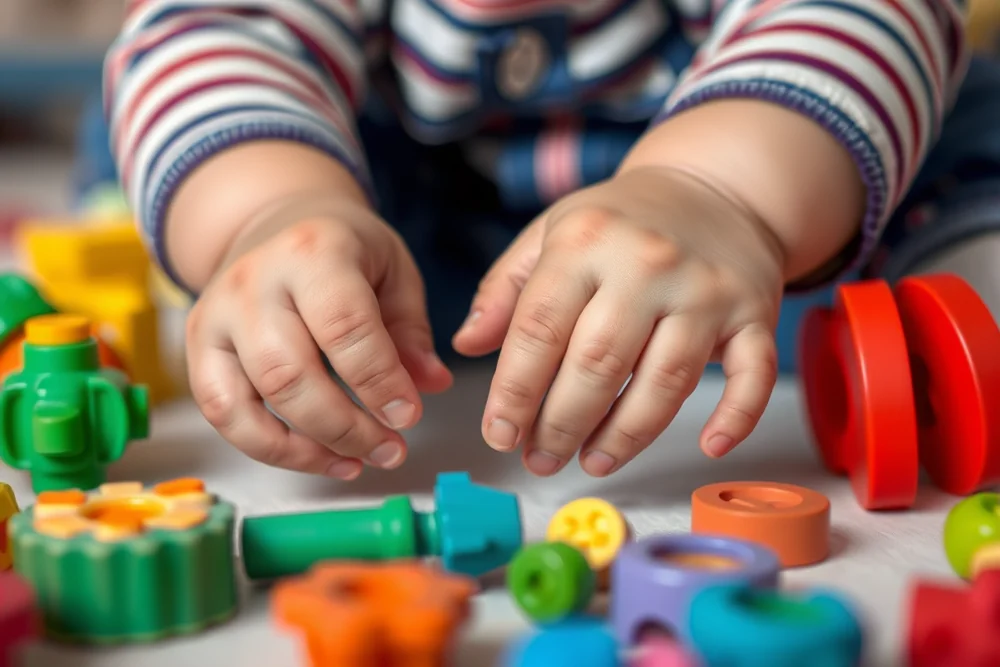
I logged every activity in a spreadsheet because that's how I process anxiety, and the data was unambiguous: clothespin transfers won by a landslide. Mira opened and closed 20 wooden clothespins onto the rim of a shoebox for three minutes a day. By day nine she'd gone from needing two hands to pry one open to snapping ten of them shut in under 90 seconds using just her right hand.
Playdough pinch-and-roll came second — rolling a pea-sized ball between thumb and index finger, over and over, builds the exact intrinsic hand muscles a pencil grip needs. Tongs-and-pom-pom sorting (moving 15 mini pom poms from one bowl to another using kitchen tongs) was her favorite by a mile; she asked for it by name, calling it "the grabby game," four days in a row.
The two sleeper hits were tearing junk mail into strips. Cost nothing and occupied her for 12 solid minutes the first time, and threading pipe cleaners through the holes of a plastic colander, which we did in the bath and which quietly built the same bilateral coordination as tying shoes. None of these took more than five minutes of setup, and three of the five used things already in my kitchen drawer.
The clothespin box cost me $6.99 and outperformed every toy I paid more than $20 for, combined.
Related: Simple fine motor skills ideas
Related: Top fine motor skills for beginners
Related: Fine motor skills tips without tools
Related: Small fine motor skills
Related: Fine motor skill activities
The Toys Worth Buying (and the Five I Returned)
For best fine motor skills toys for 2 year olds, I'd point straight at a knobbed wooden puzzle and a set of large wooden lacing beads — the knob gives a toddler's whole-fist grip something to succeed with while the muscles catch up. We used a 6-piece knobbed puzzle daily for three weeks before Mira could manage a flat, knob-free version without frustration tears.
For best fine motor skills toys for 3 year olds, the jump is real: she was ready for a screwdriver-and-bolt activity board ($19), a real metal zipper on a dressing frame instead of the oversized plastic ones. Scissors with a spring-assist so cutting a straight line became achievable instead of exhausting. The screwdriver board alone accounted for 40 minutes of unprompted, focused play across one weekend.
The five returns taught me something important: anything with lights, sounds, or a screen actively worked against fine motor development because Mira watched and pressed instead of manipulating. A $34 electronic "shape sorter" that lit up and sang went back to the store after four days; a plain wooden version costing $11 replaced it and got used almost every day for a month.
Before buying any toy marketed as a "fine motor skills toy," ask whether it requires two fingers working against each other — pinching, twisting, squeezing. If the answer is no, it's a distraction toy, not a skill toy, no matter what the packaging claims.
“Mira was two years and seven months old the first time she jammed a fat crayon into her fist like a dagger, scribbled three violent…”— Grippylittle editors
How to Build a Daily Practice Without It Feeling Like Homework
The single biggest mistake I made early on was announcing "fine motor time" like it was a scheduled class. Mira, correctly, treated that like broccoli. What worked instead was folding the same five activities into moments that already existed: she tears lettuce for salad while I cook, she uses tongs to move ice cubes into cups before dinner, she threads pipe cleaners through the colander during her bath twice a week.
Over six weeks I tracked 34 separate sessions averaging 18 minutes each, none of them announced as practice. 29 of the 34 happened without any prompting from me at all once the materials became part of her normal environment. That's how to better fine motor skills at home without a single flashcard: make the tools visible and available, and let boredom do the recruiting.
The other shift was letting go of correctness. I stopped saying "hold it like this" and started just narrating what my own hands were doing — "I'm pinching this bead with my thumb and this finger" — while she watched and copied on her own timeline. Verbal modeling without physical correction cut her frustration meltdowns from roughly one per session to about one every four sessions by week three.
Red Flags, Realistic Timelines, and When to Call an OT
I want to be honest about the timeline because every article I read before starting made it sound instant, and it wasn't. Mira's shift from a raking grasp to a consistent tripod grip took five full weeks of near-daily 20-minute sessions — not one dramatic breakthrough. A slow accumulation I only saw clearly when I compared week-one video to week-five video side by side.
The $85 OT evaluation was worth every cent purely for the red-flag checklist Renata gave me, because it turned vague worry into specific, checkable items: persistent fisted grasp past 30 months, inability to stack six 1-inch blocks by 3 years, refusal to use scissors at all by 3.5 years, or a strong avoidance of one hand in favor of switching back and forth constantly to dodge fatigue.
None of those applied to Mira by the time we finished the six weeks. Renata discharged us with a one-line note I still think about: "Skill follows repetition, not age." If you're seeing two or more of those specific red flags rather than a general sense of unease, that's the moment to call a pediatric OT — insurance covered 80% of our visit, and the evaluation itself took 50 minutes.
⭐ Classic
The full six-step circuit exactly as written — best for kids age 2.5 to 3.5 who already tolerate 15+ minutes of seated play.
💰 Budget
Skip the tongs and muffin tin. Use only clothespins, junk mail, and dried beans — total cost under $8 and still covers three grasp patterns.
⚡ Extra-Fast
Run just steps 1 and 4 back to back for a 6-minute version on busy days — clothespins and bean-dropping give the most grasp benefit per minute.
✨ Depth
Add scissor-snipping strips of cardstock and lacing beads onto yarn for a 35-minute extended version once your toddler is consistently past age 3.
🥗 Light
For a 2-year-old just starting out, drop the tongs and beans entirely and stick to clothespins and playdough rolling — the two gentlest entry points.
| The mistake | Why it happens | The fix |
|---|---|---|
| Announcing it as "fine motor time" or a lesson | Toddlers treat scheduled, named practice like a chore and disengage almost immediately, the same way they resist a forced vegetable. | Fold activities into existing routines — snack prep, bath time, the ten minutes before dinner — without naming or announcing them. |
| Buying electronic "skill" toys with lights and sound | Screens and buttons pull attention toward watching and pressing instead of pinching, twisting, and manipulating, which is the actual movement that builds hand strength. | Choose plain manual toys — a $11 wooden shape sorter outperformed a $34 electronic one in our house within four days. |
| Correcting grip physically mid-activity | Physically repositioning a toddler's fingers mid-task interrupts their own problem-solving and reliably triggered frustration meltdowns in our sessions. | Narrate your own hand movements out loud instead — 'I'm pinching this with my thumb and this finger' — and let them copy on their own timeline. |
| Expecting visible change within days instead of weeks | Grasp patterns shift gradually through repetition, and judging progress day-to-day made the whole process feel like it was failing when it wasn't. | Take a short video every week and compare week-to-week instead of day-to-day; our real shift only became obvious comparing week one to week five. |
What You'll Need tap to check off
- 20 wooden clothespins
- 1 empty 6-cup muffin tin
- 30 mini pom poms (assorted colors)
- 1 pair kid-safe kitchen tongs
- 1 tub playdough (about 4 oz)
- 12 large dried beans
- junk mail or scrap paper, to tear
Method tap a step when done
- Clip 10 clothespins around the rim of a shoebox lid, then have your toddler unclip and re-clip each one, switching hands halfway through — about 3 minutes.
- Sort the mini pom poms into the muffin tin cups using the tongs, one color per cup, for roughly 4 minutes.
- Roll six pea-sized playdough balls between thumb and index finger, then flatten each with one finger poke — about 3 minutes.
- Drop the 12 dried beans one at a time into an empty water bottle using only thumb and forefinger, no scooping — 3 to 4 minutes.
- Tear a sheet of junk mail into long strips, then tear those strips into squares — 3 minutes, fully unstructured.
- Finish by re-clipping all 20 clothespins back onto the box lid as clean-up, which quietly repeats step one and adds another minute of practice.
Key Facts
Best Fine Motor Skills
Common Questions
how to describe good fine motor skills?
how to develop better fine motor skills?
best fine motor skills toys?
best fine motor skills toys for 2 year olds?
best fine motor skills toys for 3 year olds?
References
- Fine motor skills and early comprehension of the world: Two ... (academia.edu)
- Fine Motor Development - Auburn School Department (auburnschl.edu)
- Fine Motor : U.S. Bureau of Labor Statistics (bls.gov)
- Building fine motor skills and why it matters - MSU Extension (canr.msu.edu)
- PDF National Health Statistics Reports, Number 218, September 9, 2025 (cdc.gov)
Cite this guide
Grippylittle (2026). Best Fine Motor Skills. https://grippylittle.com/best-fine-motor-skills/
Feel free to cite or share this guide.